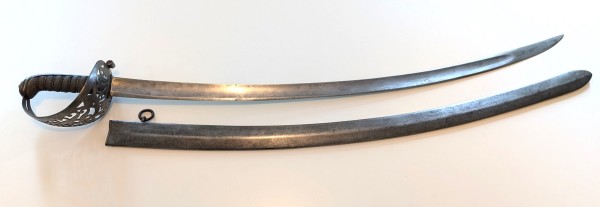
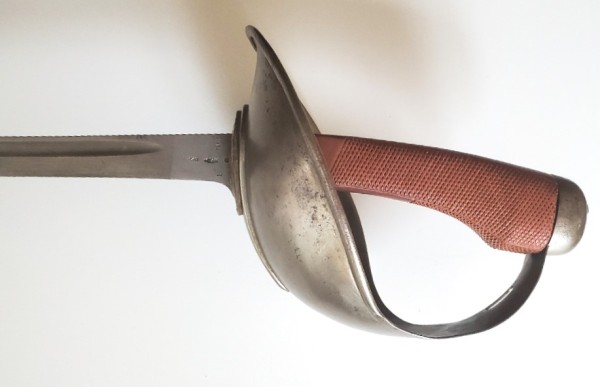
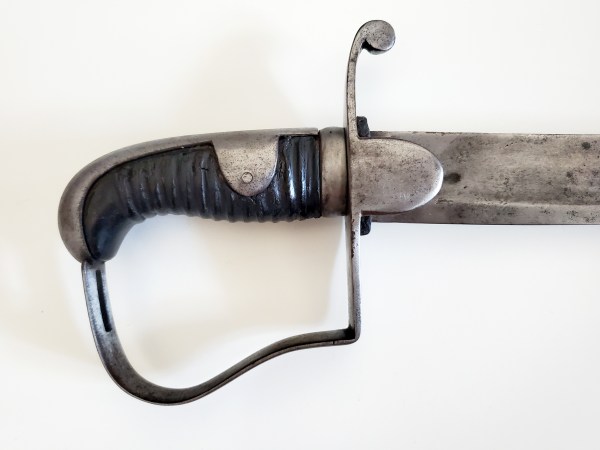
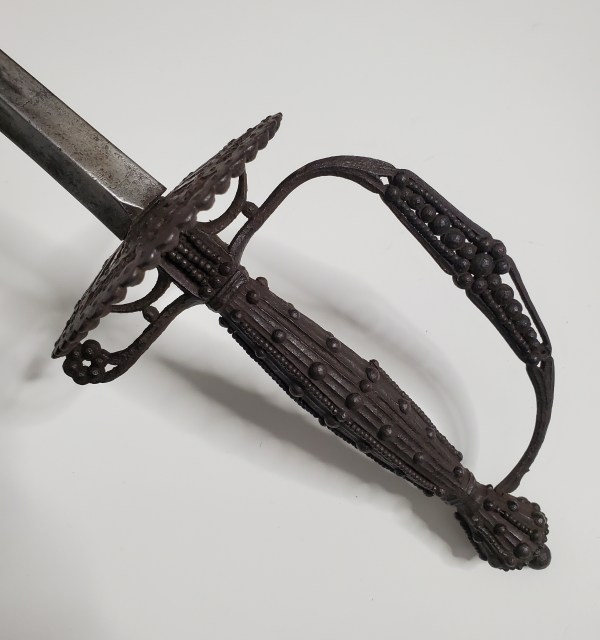
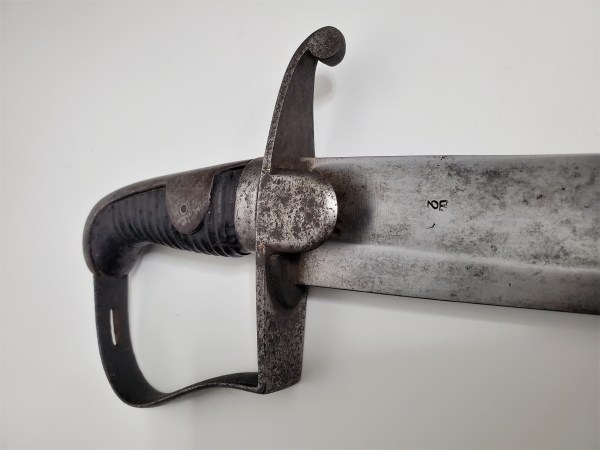
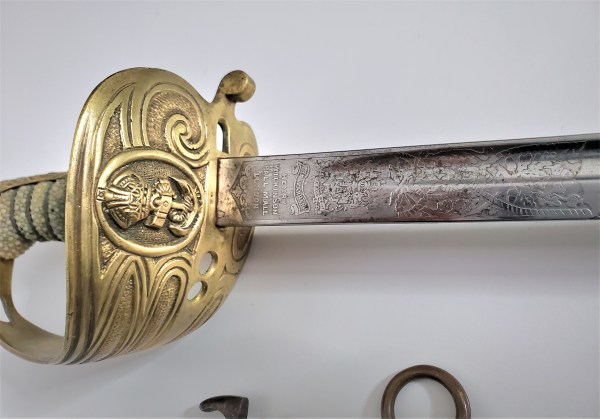
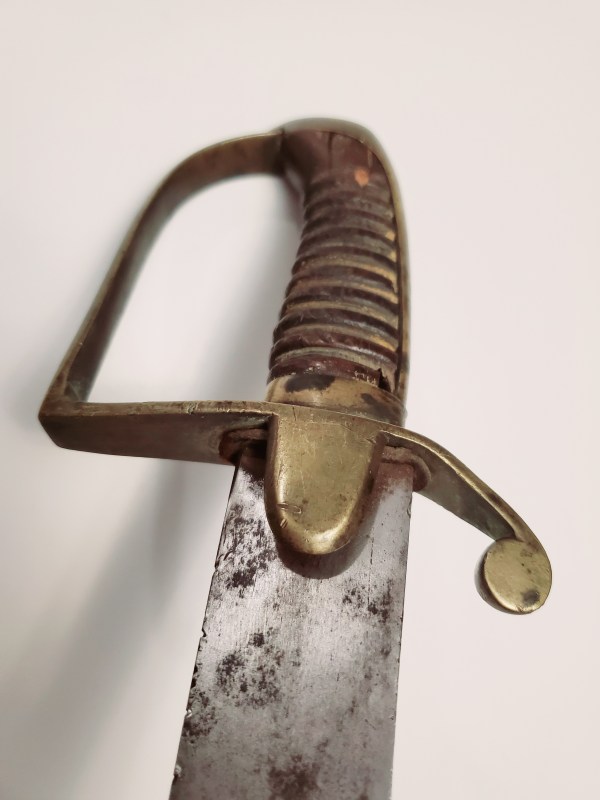
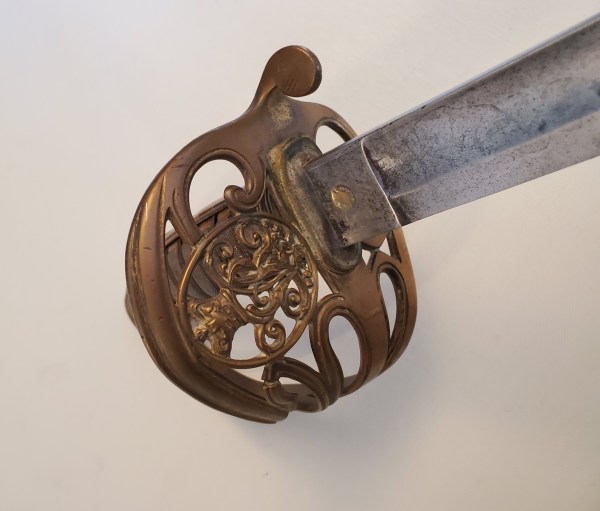
Actual heavy cavalry officer sabres are rare, but this one is actually unique. This is a fairly early version of the pattern, one fitted with an actual French Napoleonic cavalry officer blade. The blade is indeed of the an XI model, meant for light cavalry and artillery officers. While most of the decor is now... Continue Reading →
SOLD- British 1845 infantry sabre variant
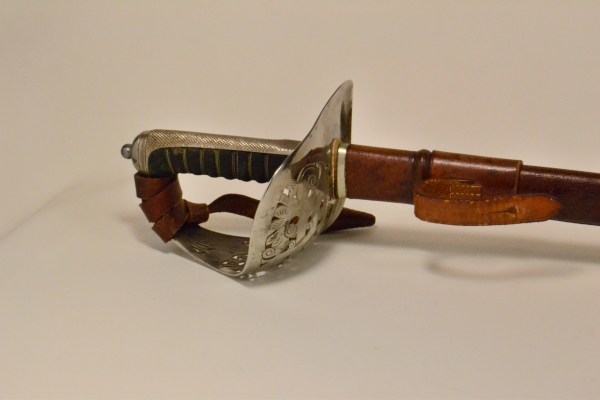
This unusual sabre is an unmarked 1845 infantry officer model, with a non regulation two bar guard. One branch decorated with oak leaves, the other with acanthus. It is not certain if this sword was indeed made for a British officer, or used in a different country. The blade is fairly massive compared to most... Continue Reading →
SOLD – 1845 British Infantry Officer Sabre – By Mole
This sabre was retailed by Firmin and made by Robert Mole, as seen by the typical proof disc associated with this reputable maker. Based on the overall style and the retailer's mark, it was probably made sometime between the 1850s to 60s. This is a fairly typical example of an 1845, except for the fact... Continue Reading →
SOLD – British 1908 Cavalry Sword – Wilkinson, WW1 era
For sale, this nearly pristine example of an iconic sword, used in the First World War, and made by the most renowned British company of the time, Wilkinson. The sword has a few blemished that should be easily removed with very little effort. It is service sharpened and is very solid, with all parts matching,... Continue Reading →
SOLD – Australian 1907 Lee Enfield bayonet
This sword bayonet was made to be used with the Lee-Enfield no.1 MkIII rifle, which was used during WW1 and WW2. This specific one was made in 1918 at Lithgow, while the scabbard was made in 1943 by Mangrovite and SAF-3, Orange. It's in perfect shape with most of the original finish still present on... Continue Reading →
SOLD – British 1821 Cavalry officer sabre
For sale, a great example of this unique sword pattern carried by British officers from the 1820s to the 1840s, and even beyond. The 1821 is the first British pattern to include the famous pipeback blade designed by Prosser. This one was retailed by Hebbert and Hume, at 8 Pall Mall street, which means it... Continue Reading →
SOLD – British 1796 light cavalry sabre – owner’s initials
This is a nice, and rather unique, 1796 sabre from the British army. It was made by Craven and Bradbury. This example is a trooper model, but the owner's initials were inscribed on the guard and the scabbard. This could be an officer who wanted an enlisted man's sword, or perhaps a gift to a... Continue Reading →
SOLD – British 1796 Light Cavalry sabre
For sale, an example of the famous 1796 light cavalry sabre which equipped the British army, as well as Prussian and Dutch, during the Napoleonic Wars. This one was made by Thomas Craven of Birmingham. It is in good shape, in need of a complete cleanup, but with all parts, including scabbard. No unit markings... Continue Reading →
SOLD – British 1896 cavalry officer sabre – Indian service – Pillin
For sale, this beautiful example of the 1896 universal cavalry officer sabre. This one was made by Pillin, as indicated by the proof mark and the serial number. Interestingly, the sabre is also equipped with a scabbard that was usually carried by officers stationed in India. The scabbard has a matching serial number to the... Continue Reading →
SOLD – British 1853 cavalry sabre – Prince Edward Island’s Volunteers
This 1853 has an interesting history, being marked to the Prince Edward Island's volunteer cavalry. As was often the case for volunteer units in North America, the sword's scabbard was modified to fit the 1885 pattern configuration. It is not a mismatch, as the 1885 has a different throat piece. This is an 1853 scabbard... Continue Reading →
SOLD- British 1796 Light Cavalry Sabre – By Osborn
A nice example of this iconic sabre in great overall shape. The blade has some traces of surface pitting, which gives it patina and character. It was service sharpened. The grip is very solid, with no rattle. The sword was made by Osborn and marked to the Ayrshire Yeomanry Cavalry in Scotland. SOLD
SOLD – Late 18th century smallsword
For sale this example of a mourning smallsword, usually carried as the name implies during the first times of a mourning. This cut steel hilt is profusely decorated with steel beads on wires. Some are missing, though this not distract significantly. The blade is rather short, but does not appear to have been shortened. There... Continue Reading →
SOLD – British 1896 cavalry officer sword – by Wilkinson
For sale a patent solid hilt of an 1896 pattern cavalry officer sword. This specific one was carried by Major John Heywood Jocelyn McClintock. Major McClintock was a lieutenant in the 18th hussars during the Second Boer War, and subsequently became a major in the 2nd life guard during the First World War. This sword... Continue Reading →
SOLD- British 1796 Light cavalry sabre – by Dawes
For sale, an iconic 1796 light cavalry sabre, made by Dawes of Birmingham. This sabre is in surprisingly good shape, is very solid with no rattle. Although the scabbard is in near relic condition, the rest of the sword held up well, especially the blade, which was protected by a thick layer of grease, allowing... Continue Reading →
SOLD- British naval officer sabre – By Wilkinson
This is a very nice example of a best quality Wilkinson sabre made in 1913 by the famous high end sword company. The sword is a solid hilt type, meaning that it does not have the swivel counter-guard that was regulation on this pattern. It was retailed by Gieve Matthews and Seagrove Ltd. The scabbard... Continue Reading →
SOLD – British Royal Artillery “Spanish pattern” hanger
For sale, a fairly elusive "Spanish pattern" worn by artillerymen of the British Army during the Napoleonic wars. This pattern was introduced during the Peninsular war, hence the name, and was carried until 1826. This example has had a full life. The leather on the grip is gone, but the hilt is in fair shape,... Continue Reading →
SOLD – WW1 era 1845 artillery officer sabre – by Wilkinson
This is a best quality sword made by Wilkinson sometime around WW1 based on the company's etching. The blade is a bit of a mystery, being devoid of most etchings you would expect to see, as well as sporting no serial number and a rather rare Wilkinson inscription. There is no doubt though that this... Continue Reading →
SOLD – 1845 British Infantry Officer Sabre – Attributed
A fine 1845 sabre, the maker is unknown, but based on the initials and the family crest, it was made for H.H. Harwood. This would probably be Henry Harwood Esq. (1809-1886) who became Deputy Lieutenant to Middlesex County in 1867. Although now purely ceremonial, the Lieutenancy used to be responsible for the various militias in... Continue Reading →
Sold – 1897 Infantry Officer by Pillin – WW1 dated and attributed
It is rare to find an 1897, apart from a Wilkinson, which can be specifically pointed to WW1, as George V whose cipher can be found on these blades reigned from 1910 to 1936. This sword is such a rare find. If not for a few faint blemishes, one could believe that this sword had been... Continue Reading →
Sold -1821 British Cavalry Officer pipeback sabre – by Gibbons
This is a gorgeous example of the 1821 officer sabre made by a scarce maker or retailer: J. Gibbons of Canterbury. It is rare that engravings remain on earlier blades as they tend to be fairly shallow, but in this case the blade is in pristine condition. This early Victorian sabre was likely made for... Continue Reading →
Sold – 1908 British Cavalry sword
The 1908 is one of the most famous swords for having been used in the First World War, and being one of the last swords created for combat. Although usually used by troopers, this particular one might have been used by an officer, judging by the cut down scabbard's rings. This is a practice that... Continue Reading →
Sold – 1845 Rifles Officer Sabre by Mole
For sale this unusual example of a Rifles Officer sabre of the 1845 pattern (with Wilkinson designed blade). The blade is in pristine shape, with no corrosion. The blade is unmarked, except for the usual etchings of a Victorian Rifle Regiment. It does bear the usual proof mark of Mole, one of the top sword... Continue Reading →